Strategy, Design, Development
Two days to write. A month to make right.
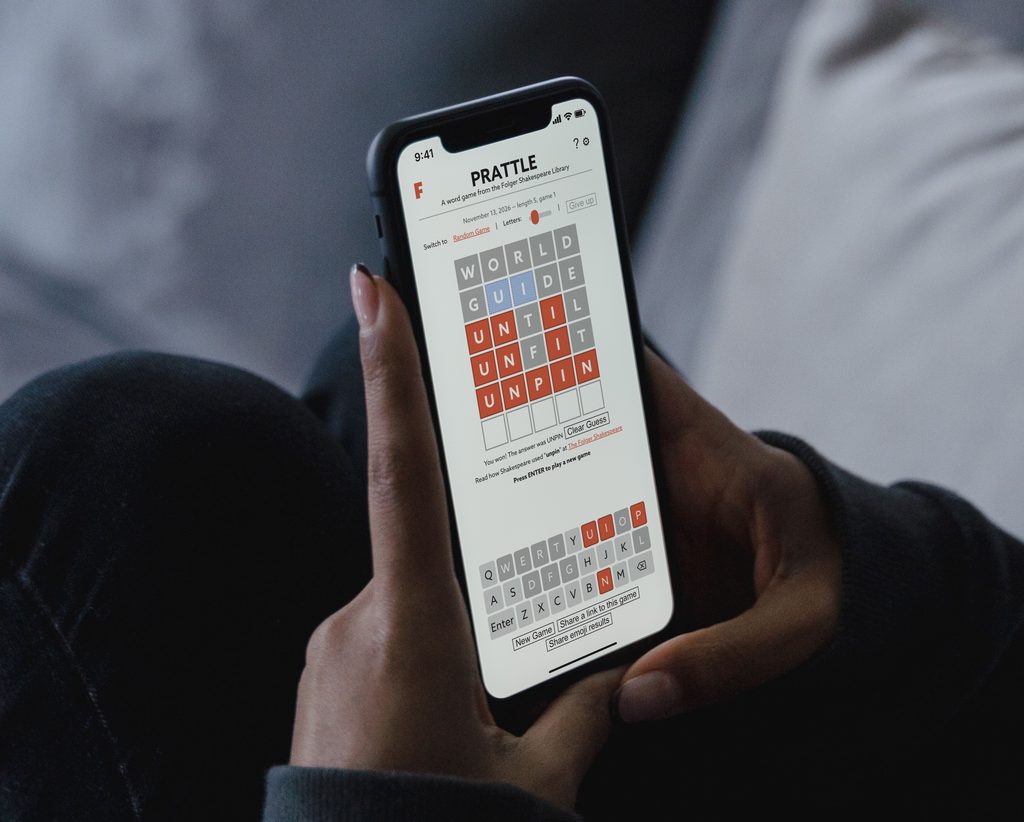
This project started, naturally, when the Wordle craze was starting to hit the news. In a classic water-cooler conversation, one of my teammates wistfully said “Wouldn’t it be nice if we could just make games?” I had been taking the XR Development program with the University of Toronto’s Continuing Education department in my off-time, and I was about to begin Games for Change’s Game Plan training program, so of course this was a thought I was having a lot.
Well, I thought to myself, what’s stopping us? Development time, for one: I was the only front end developer at the Folger, and my time was chronically accounted for. The need to get the messaging right was another: the Folger is a leading voice in the legacy of Shakespeare, and in the US the Folger brand is virtually synonymous with Shakespeare, particularly in classrooms. Any product the Folger puts out has a responsibility to represent Shakespeare with integrity, and a duty of care to its audience, which almost always includes minors.
So, I set myself two goals: create a simple Wordle-style game prototype that takes up as little development time as possible, and is created with the care and respect for the subject matter that had become second nature to me as the day-to-day custodian of the Folger Shakespeare corpus. The first goal was easy thanks to a code repo by Belgian developer Lynn, who made an open-source Wordle clone that became the basis for Prattle, and with the help of the Folger Shakespeare API, which allowed me to generate a possible solution corpus in minutes based on simple parameters. I reskinned the app according to Folger branding, and had a working prototype in less than two days (which, in the days before vibe coding, was considered fast).
The second part was where judgment, consideration of audience and context, and time, came into play. One might assume that any word in the Shakespeare corpus would make a good answer for a Wordle-style game. But out of the context of the plays and poems, there are words that are NSFW, inappropriate for children, or just not consistent with the spirit of a fun, casual game. Our rationale can be summed up like this: when someone is playing our game, we want them to have fun; we will do what is reasonable to make sure no-one has to use a word they’re not comfortable with, or that brings up hard feelings, in order to be able to solve the puzzle.
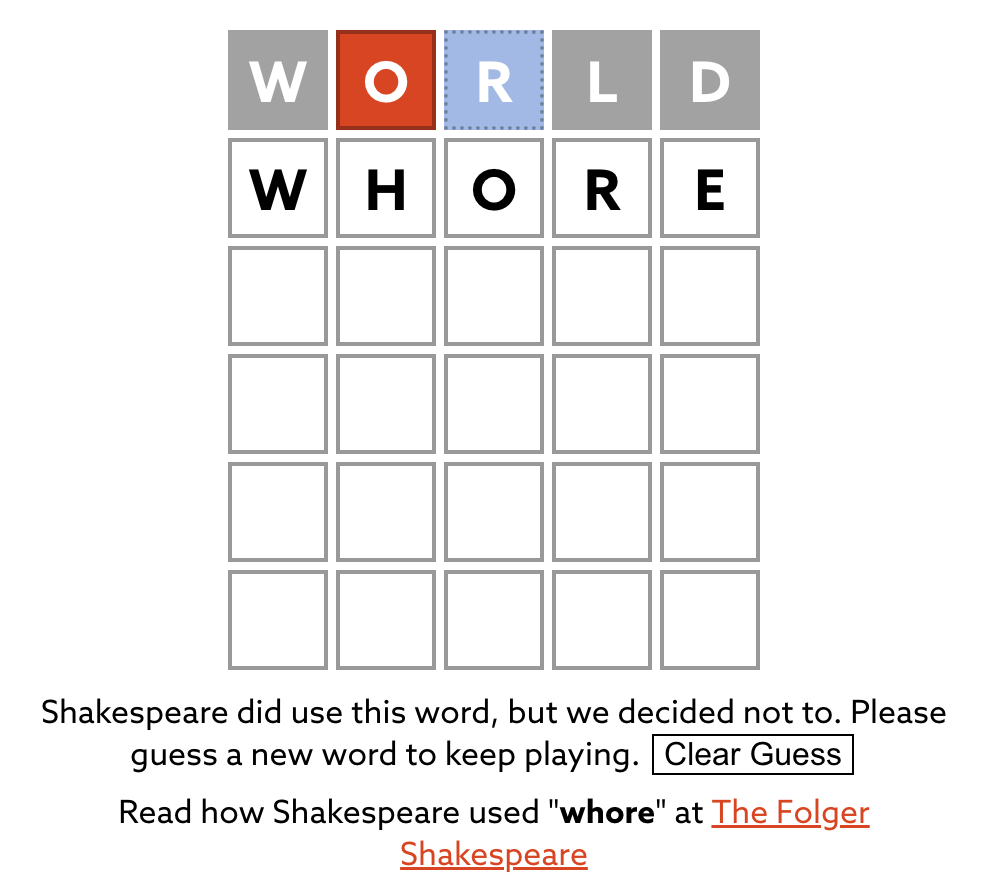
As a team, we established some rules for excluding terms – explicit terms referring to extreme physical or sexual violence were out, as well as derogatory, racialized, and sexualized words, with particular sensitivity to how certain words might impact particular segments of the American audience. We combed through the list of tens of thousands of Shakespeare’s words, argued when necessary (I took a strong stance on not excluding anatomical terms for body parts considered sexual – so if the answer for the daily six-word is ever “breast”, you know who to thank/blame), and came up with a final corpus of approximately 13,000 possible answers. I am a strong proponent of both transparency and consistent game mechanics, so I coded an exception to handle when a player tried out an excluded word: the game will not just silently reject your answer and leave you confused, but tell you: Shakespeare did use this term, but it’s not part of our game. I also included the ability to see how Shakespeare used the excluded word in context.
Not everyone agreed with our approach. For instance, Roy Thomas, former editor-in-chief at Marvel Comics, commented to Reason Magazine that “[t]his anti-free speech, anti-intellectual, anti-common-sense action deserves all the scorn it can get” (read the article). We noted the objection, but we had already done the hard work of deciding how we wanted to balance our responsibility to represent the subject matter transparently vs our duty to care for our players and protect them from unnecessary harm with the choices we make. We were satisfied that we had struck the right balance. Great works of art, like a Shakespeare play, or even a Marvel comic, ask you to wager your comfort in exchange for the possibility of expanding your worldview. A casual mobile game like Prattle asks that, at most, you wager your pride – that you will come out elated by a win, or crestfallen by a defeat. This is what we wanted Prattle to ask of our players, and if playing our game leads someone to play the much more serious and rewarding game of immersing oneself in a Shakespeare play, then we achieved something greater than we dared hope to accomplish.
Prattle was an immediate success, garnering a quarter-million plays in the first months, and experiencing an astonishingly long tail that continues to persist.